Leave Your Message

China Top Dumbbell Rack Manufacturers for Global Buyers

China has become a major sourcing destination for commercial strength-training equipment. Its Dumbbell Rack manufacturers serve gyms, hotels, schools, studios, and international distributors. However, factory selection should involve more than comparing prices.

A dependable supplier should explain steel thickness, weld quality, frame stability, coating performance, and maximum load capacity. Buyers should also inspect rack dimensions, dumbbell compatibility, packaging protection, and replacement-part support. A rack that looks strong in a catalog may still wobble on a busy gym floor. That detail matters.

Strength-equipment designer Chris Duffin offers a useful principle: “A rack should support the lifter, not compete with the lift.” The same idea applies to storage equipment. A well-designed Dumbbell Rack should keep weights organized, accessible, and safely supported during repeated daily use. Manufacturers with practical experience usually provide drawings, testing information, sample approvals, and clear production timelines. They should not hide behind attractive photographs.

This guide reviews leading Chinese manufacturers from a global buyer’s perspective. It considers product construction, customization ability, quality-control practices, export experience, and communication reliability. Some suppliers may offer excellent prices but limited after-sales service. Others may produce strong frames but lack flexible branding options. Buyers must weigh those differences carefully.

I may be overly cautious about documentation. Still, missing details often create expensive problems later. The best decision is rarely the cheapest quotation. It is the supplier that consistently delivers a stable, durable, and practical Dumbbell Rack for real training environments.

China Top Dumbbell Rack Manufacturers for Global Buyers

China’s Role in the Global Dumbbell Rack Manufacturing Industry

China’s role in global dumbbell rack manufacturing reflects the wider expansion of fitness equipment demand. Grand View Research valued the global fitness equipment market at approximately USD 16.6 billion in 2023. Its report projects continued growth through 2030, supported by commercial gyms, hotels, rehabilitation centers, and home training spaces. Dumbbell racks benefit from this trend because they improve floor safety and equipment organization. Small details matter. A stable rack should resist tipping, protect painted dumbbells, and fit narrow training areas.

Chinese manufacturers serve this demand through integrated metalworking supply chains. Many factories can cut steel, weld frames, apply powder coating, and pack export orders within one production system. This can shorten lead times and support customized heights, tray angles, and storage capacities.

UN Comtrade data under HS 950691 shows strong international trade in fitness equipment, although this code combines racks with other exercise products. That limitation deserves attention. Exact rack export values are difficult to isolate.

For global buyers, factory evaluation should include weld consistency, load testing records, coating thickness, packaging design, and documented quality controls. A rack may look solid in a showroom yet deform under repeated commercial use. Requesting sample inspections and production photographs is practical. So is checking corrosion performance for humid markets. China offers scale and customization, but supplier selection still requires technical verification, not price comparison alone.

Key Types of Dumbbell Racks Made by Chinese Manufacturers

China Top Dumbbell Rack Manufacturers for Global Buyers

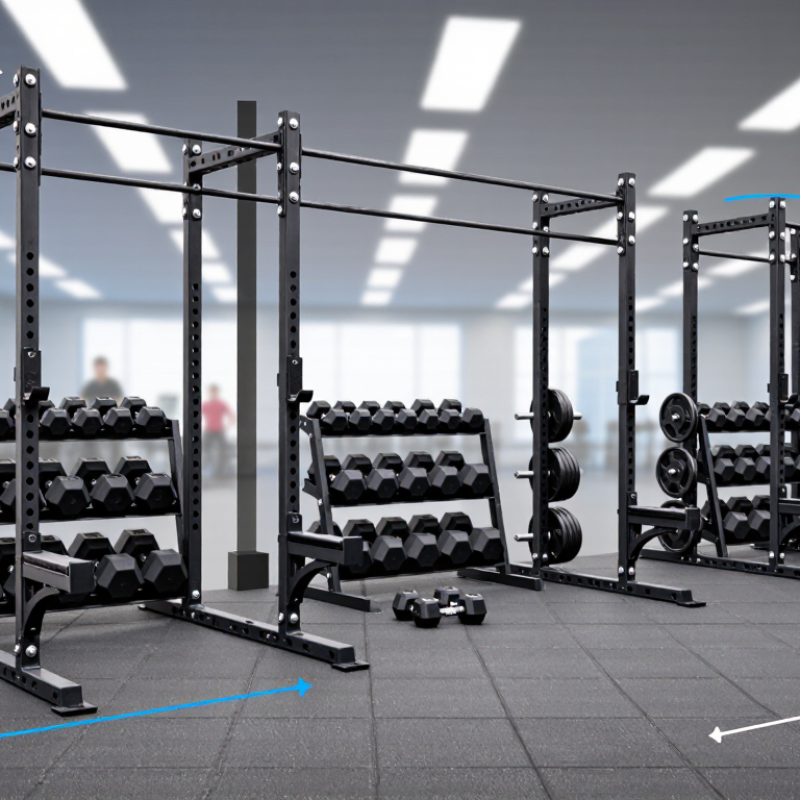
Chinese manufacturers produce several dumbbell rack types for gyms, studios, hotels, and home training rooms. Vertical racks save floor space and suit lighter adjustable dumbbells. Horizontal racks offer faster access and better stability for busy training areas. Three-tier racks store multiple weights neatly, while angled trays reduce hand movement during workouts. Wall-mounted designs are useful when floor space is limited, but installers must verify wall strength before ordering.

Many factories also make modular racks with removable trays, rubber feet, and reinforced steel frames. Custom options may include different widths, powder-coated finishes, laser-cut logos, and packaging for export shipping. In my experience, checking weld points and tray edges reveals more than attractive product photos. A low-cost rack may look practical, yet thin steel can bend under repeated commercial use. I once focused too much on dimensions and overlooked the rack’s actual load rating. That mistake was avoidable.

Tips: Ask for material thickness, tested capacity, coating specifications, and assembly drawings. Request clear photos of welds and base connections. Confirm whether the quoted capacity applies to each tray or the whole rack. A sample order can expose unstable feet, poor finishing, or confusing instructions before larger purchasing decisions.

China Top Dumbbell Rack Manufacturers for Global Buyers

Key types of dumbbell racks commonly produced for commercial gyms, fitness studios, and home-use equipment markets.

The chart compares typical dumbbell-position capacity by rack type. Two-tier and three-tier racks generally provide the highest storage density, while vertical and tree-style racks are designed for compact spaces. Actual capacity varies by frame dimensions, dumbbell head shape, and manufacturer specifications.

How to Evaluate China’s Dumbbell Rack Suppliers

China Top Dumbbell Rack Manufacturers for Global Buyers

When evaluating China’s dumbbell rack suppliers, inspect more than catalog photos. Request factory videos showing cutting, welding, grinding, powder coating, and final packing. Ask for evidence. A reliable supplier should provide material specifications, load-test records, inspection reports, and clear production timelines. Check whether the steel thickness matches the quotation. Thin tubing may reduce cost, but it can twist under uneven loads.

Ask for a sample rack before placing a large order. Measure its height, footprint, tray angle, weld consistency, and rubber contact points. Place dumbbells on every tier, not only the center. Test movement and check for sharp edges after assembly. Packaging also matters. Corner protectors, moisture barriers, and labeled hardware reduce damage during long-distance shipping. Confirm carton dimensions and total weight before requesting freight rates.

Communication reveals practical competence. Suppliers should answer technical questions directly and explain tolerance limits, replacement procedures, and quality checks. Be cautious when responses remain vague. A polished factory video can still hide weak controls. One common mistake is choosing the lowest quotation too quickly. The cheaper frame may require stronger packaging or later repairs. That calculation is easy to miss. Compare full landed costs, sample results, production capacity, and documented inspection steps. Consider independent pre-shipment inspection when the order value is significant. Even experienced buyers sometimes overlook small details, such as bolt compatibility or storage access. Measure twice. Document every requirement.

Manufacturing Standards, Materials, and Quality Control

China’s leading dumbbell rack manufacturers serve buyers who need stable, repeatable production. In factory audits, I look beyond polished samples. I check steel thickness, weld penetration, surface preparation, and assembly accuracy. These details affect safety and service life.

Material selection starts with structural steel tubing or formed sheet steel. Thicker walls usually improve load resistance, but they also increase shipping weight. Manufacturers should document material grades and incoming inspections. Powder coating needs clean metal, controlled curing, and even coverage. A rough corner can damage hands or equipment. Rubber feet should resist slipping and floor marking.

Quality control must continue after production. Inspectors can measure frame dimensions, check welds visually, and test representative racks under heavy loads. They should also examine bolts, hooks, trays, and protective caps. Batch records make defects easier to trace. Packaging tests matter too. A strong rack can still arrive bent after poor pallet protection.

No factory gets every batch perfect. That point deserves attention. Buyers should request inspection reports, tolerance data, and corrective-action records before placing large orders. Independent testing adds confidence, especially when specifications are unclear. In my experience, reliable suppliers welcome difficult questions, although some documents may still need closer verification. Clear drawings and signed samples reduce misunderstandings between overseas buyers and production teams.

China Top Dumbbell Rack Manufacturers for Global Buyers - Manufacturing Standards, Materials, and Quality Control
Evaluation Dimension Common Manufacturing Practice Recommended Technical Requirement Applicable Standard or Reference Typical Quality-Control Method Relevance for Global Buyers
Main Frame Material Welded carbon-steel tubing is widely used for commercial dumbbell racks because it offers high stiffness and efficient production. Specify the steel grade, tube dimensions, wall thickness, and allowable dimensional tolerance in the purchase specification. ASTM A500/A500M or EN 10219 reference, where applicable Incoming material verification, tube-dimension measurement, and review of material certificates. Helps buyers compare structural capacity and avoid substitutions with thinner or lower-grade tubing.
Dumbbell Trays and Saddles Trays are commonly made from formed steel sheet with polymer, rubber, or molded-plastic contact surfaces. Contact surfaces should support the specified dumbbell sizes without sharp edges, excessive movement, or metal-to-metal contact. Product specification and applicable user-safety requirements in the destination market Fit checks using representative dumbbells, edge inspection, and load-distribution checks. Reduces the risk of scratching dumbbells, tray deformation, and unstable storage.
Welding Quality Robotic or manual MIG/MAG welding may be used for frame joints, brackets, and support components. Welds should be continuous where required by the design, free from visible cracks and incomplete fusion, and properly dressed in user-contact areas. ISO 5817 quality levels may be used as a welding-quality reference Visual weld inspection, dimensional checks, and non-destructive testing when required by risk or contract specification. Consistent weld quality improves fatigue resistance and reduces structural failure risk during repeated use.
Structural Load Capacity Capacity depends on frame geometry, weld design, tray support, base width, and the distribution of stored dumbbells. Declare a tested maximum working load and define whether the rating applies per tray, per tier, or to the complete rack. Manufacturer-engineered test protocol; purchaser-defined safety factor Static load testing with the load distributed across the rack, followed by inspection for permanent deformation or instability. Allows facility operators to select racks suitable for home, studio, or commercial-gym applications.
Dimensional Accuracy Common checkpoints include overall height, width, depth, tray spacing, hole position, and base levelness. Use a signed drawing with tolerances before mass production; critical assembly dimensions should be separately identified. ISO 2768 may be referenced for general dimensional tolerances when suitable First-article inspection, calibrated measuring tools, and sampling inspection during production. Accurate dimensions support container planning, installation, compatibility, and repeat orders.
Surface Preparation Steel parts are typically degreased, cleaned, and treated before powder coating or another protective finish. Surface should be free from oil, loose scale, weld spatter, and visible corrosion before coating. ISO 8501-1 can be used as a reference for visual assessment of steel surface preparation Visual inspection, cleanliness checks, and process-record review. Proper preparation is essential for coating adhesion and long-term corrosion resistance.
Powder-Coating Finish Thermoset powder coating is commonly selected for indoor fitness equipment because it provides a durable decorative finish. Specify color reference, gloss level, coating thickness range, edge coverage, and permitted visual defects. ISO 12944 for corrosion-protection principles; ASTM D3359 for adhesion testing reference Coating-thickness measurement, cross-cut adhesion testing, and visual inspection under controlled lighting. Standardized finish requirements make quality comparisons more objective across production lots.
Corrosion Protection Protection may include powder coating, zinc-plated fasteners, stainless-steel hardware, or a combination of treatments. Hardware and coating systems should be selected according to indoor humidity, cleaning chemicals, and expected use conditions. ISO 9227 salt-spray testing may be used for comparative coating evaluation, not as a direct lifetime guarantee Coating-system verification, salt-spray testing when contractually required, and inspection after chemical exposure testing. Helps buyers match the rack to gyms, hotel fitness rooms, studios, and other environments.
Fasteners and Hardware Bolted joints commonly use carbon-steel or stainless-steel fasteners with washers, locknuts, or thread-locking solutions. Specify fastener size, strength class, corrosion grade, tightening torque, and replacement availability. ISO 898-1 for mechanical properties of carbon-steel fasteners; ISO 3506 for stainless-steel fasteners Hardware count, visual verification, thread inspection, and torque checks on sampled assemblies. Correct hardware improves assembly safety, serviceability, and resistance to loosening during vibration.
Stability and Leveling Wide bases, non-slip feet, adjustable levelers, and anti-tip features may be used depending on rack height and design. The fully assembled rack should remain stable under the specified load and on the floor conditions stated in the instructions. Risk-based engineering assessment and destination-market safety requirements Floor-contact inspection, wobble testing, loaded stability testing, and verification of leveler adjustment. Important for preventing tipping, floor damage, and user injury in high-traffic facilities.
Rubber and Plastic Components Protective feet, tray liners, end caps, and bumpers are commonly made from rubber, TPE, PVC, or engineered plastics. Materials should resist expected compression, abrasion, cleaning agents, and temperature conditions. Material-specific supplier specifications; chemical compliance requirements of the destination market Visual inspection, dimensional checks, hardness testing where specified, and fit testing. Reliable non-metal components reduce noise, floor marking, and damage to stored weights.
Factory Quality System Structured factories may use documented incoming, in-process, and final inspection procedures supported by traceable records. Require controlled drawings, inspection plans, nonconformance procedures, corrective-action records, and batch traceability. ISO 9001 quality-management principles Document review, process audit, production inspection, and corrective-action verification. A documented system improves repeatability and provides evidence when quality issues arise.
Pre-Shipment Inspection Inspection normally covers appearance, dimensions, assembly, accessories, packaging, labels, and quantity. Use an approved inspection checklist with acceptance limits and define the sampling plan before production starts. ISO 2859-1 may be used as a reference for attribute-based sampling inspection Random carton selection, functional checks, measurement, photo records, and inspection reports. Provides an objective release decision before goods leave the manufacturing facility.
Packaging and Export Protection Common packaging includes protective film, molded or corrugated inserts, individual cartons, and palletized shipments. Packaging should protect coated surfaces, prevent component movement, identify cartons clearly, and support the planned transport mode. Destination-market packaging, pallet, marking, and wood-treatment requirements Carton drop or vibration assessment when specified, packaging inspection, and container-loading checks. Good packaging reduces transit damage, claims, rework, and receiving delays.
Documentation for Buyers Typical documents include approved drawings, packing lists, inspection reports, assembly instructions, and care guidance. Documents should state dimensions, working load, assembly torque where relevant, cleaning restrictions, and maintenance intervals. Destination-market product documentation and language requirements Document review against the approved product configuration and shipment quantity. Clear documentation supports installation, safe operation, maintenance, and regulatory review.
Buyer note: The values and practices above are general industry references rather than claims about any specific manufacturer. Final requirements should be confirmed through approved drawings, product-specific testing, destination-market regulations, and a written quality agreement.

Export, Customization, and Purchasing Considerations for Global Buyers

Global buyers evaluating China’s dumbbell rack manufacturers need more than a low quotation. Export experience affects packaging, documentation, communication, and delivery control.

Ask for recent export markets, production capacity, and loading photographs. Request a sample before approving bulk production.

Small details matter. Check weld consistency, frame alignment, rubber feet, surface coating, and label placement.

An experienced supplier should explain steel thickness, weight capacity, tolerance, and testing methods.

Review test records, material certificates, and corrective-action history when available. Do not accept unsupported load claims.

Customization may include dimensions, tray angles, color, logos, carton design, and protective inserts. Send a measured drawing, not only a reference image.

Confirm whether tooling, sampling, and artwork fees are refundable. Define acceptable defects in writing.

Powder coating can look excellent in a showroom but fail after rough sea transport. Ask for corner protection, moisture control, carton strength, and pallet requirements.

For mixed containers, verify carton dimensions carefully. One overlooked centimeter can reduce usable space.

Purchasing decisions should compare total landed cost, not factory price alone.

Include tooling, inspection, inland transport, ocean freight, insurance, duties, and destination handling.

Agree on payment milestones linked to production evidence and pre-shipment inspection.

Use clear Incoterms and confirm who prepares export documents. Lead times deserve realistic attention.

A supplier may promise twenty days, yet customized racks often need longer approval cycles. Build buffer time for revisions, holidays, and port delays.

Even a careful buyer can miss a detail.

Signed specifications and retained samples remain valuable.